
The rotor removes water as vapour, not only as condensate, so drying continues at low temperature and low humidity.
DESICCANT ROTOR DEHUMIDIFIER · 17 MODELS · 200–13,000 m³/h
Desiccant rotor dehumidifiers
for process air a refrigerant unit can’t dry.
The DZL series removes moisture with a silica-gel rotor instead of a refrigerant coil, so capacity holds at low temperature and low dew point. Send your operating conditions and we return the model, the regeneration heat source and a written quotation.
Fast replies on WhatsApp MOQ 1 unit · 1-year warranty Custom voltage, 50/60 Hz
200–13,000m³/h process airflow
1.2–80kg/h dehumidification*
17published models
PROCESS AIR
DRY AIR
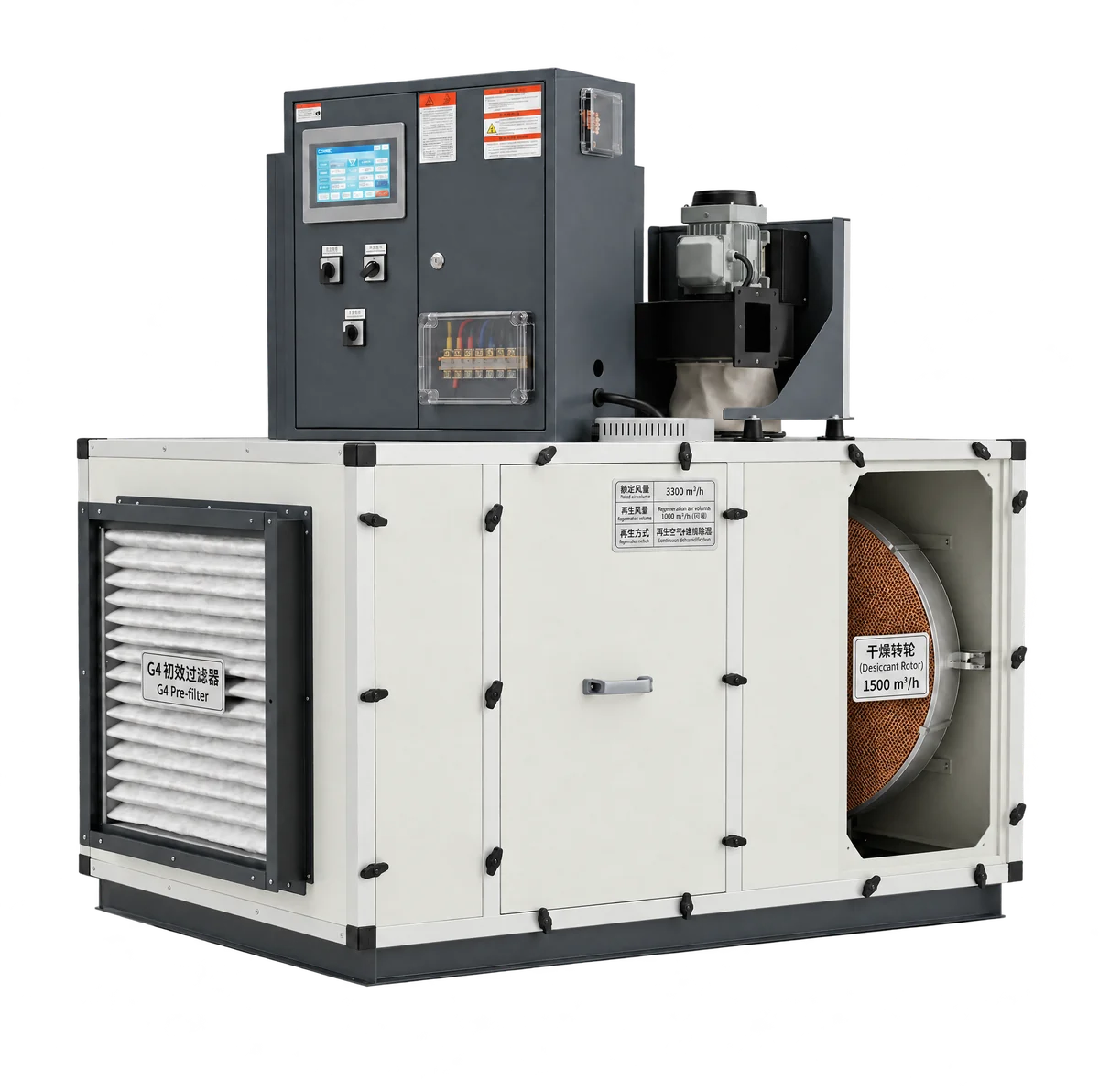
17 AVAILABLE MODELSDZL SERIES
Process airflow200–13,000 m³/h
Dehumidification1.2–80 kg/h*
1-year whole-unit warranty
Free spare parts for any problem within the warranty period
Modular design, fault self-diagnosis
The controller shows the fault; swap the faulty module on site
MOQ 1 unit
FOB, EXW or door-to-door delivery
Custom voltage and 50/60 Hz
Each unit can be built for your local power supply
01
PRODUCT OVERVIEW
When the refrigerant cycle stops,
the rotor keeps drying.
A refrigerant dehumidifier cools air below its dew point to condense moisture. As the temperature drops, frost limits how far it can go. A desiccant rotor instead passes air over a slowly turning wheel that adsorbs moisture directly, then re-activates the wheel with a heated regeneration stream. That is why the DZL series keeps removing moisture at conditions where a refrigerant cycle is no longer the right tool.
Process airflow, target humidity or dew point and inlet air condition determine the DZL capacity — not room area alone.
The rotor is re-activated by a heater. Electric heating is standard; steam, gas or waste heat can be reviewed per project.
02
IS A ROTOR THE RIGHT ANSWER?
Check the fit before you request a price.
Two technologies, two different jobs. If a refrigerant unit will do the work, we will tell you — it is usually the cheaper machine to buy and to run.
| Refrigerant / condensing unit | Desiccant rotor — DZL series | |
|---|---|---|
| Humidity level it holds | Limited by coil surface temperature; frost forms below 0 °C and stops the coil | Stable low humidity, down to low dew points |
| Output at low temperature | Falls sharply as the space gets colder | Largely unaffected by a cold inlet |
| Where it belongs | Comfort and general space humidity control at normal room temperature | Process air, hygroscopic products, cold rooms, dry rooms |
| Main energy input | Compressor electricity | Regeneration heat — electric, steam, gas or waste heat |
A rule of thumb: if your target sits around 45–50 % RH at normal room temperature and you have no low-temperature or low-dew-point requirement, a refrigerant dehumidifier is usually the cheaper answer — see the DS / DSG / DG range. The DZL rotor becomes the right choice when the target is below what a coil can reach, or when the process air is already cold.
Not sure which side of that line you are on?
Send the conditions
Send the inlet condition and the humidity you need to hold. We will tell you which technology fits before we talk about price.
03
INSIDE THE TECHNOLOGY
What makes the rotor different
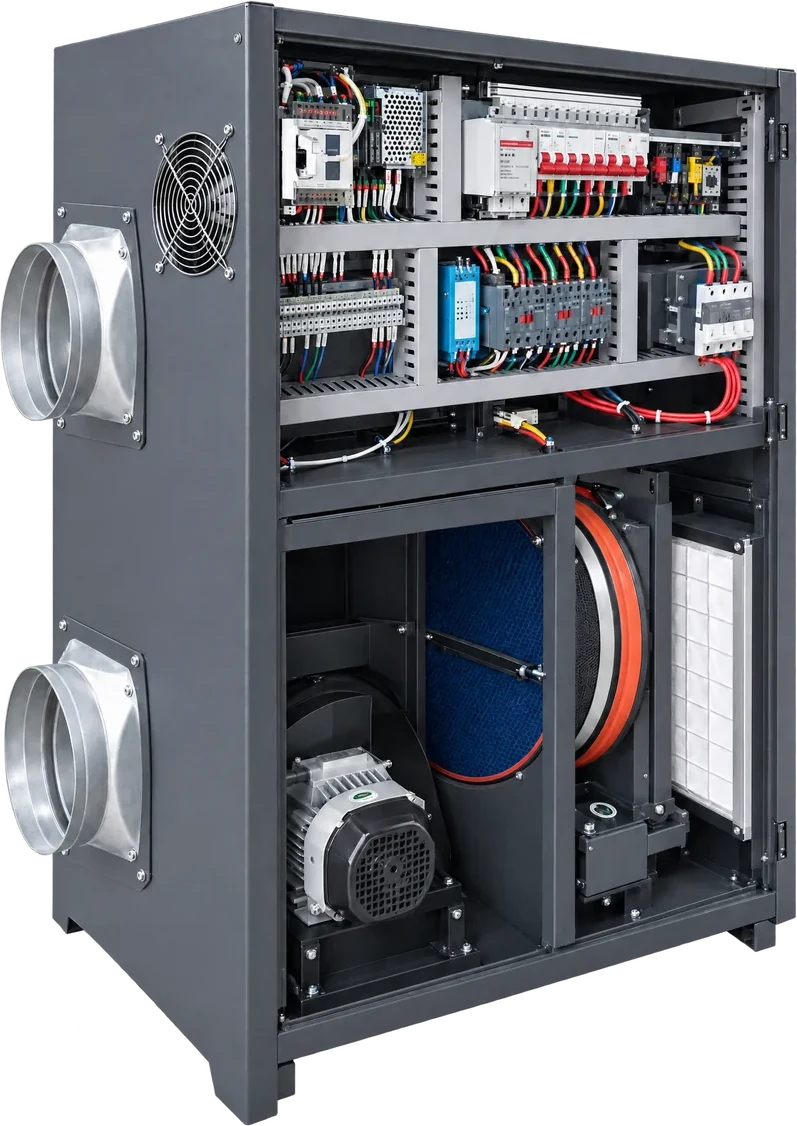
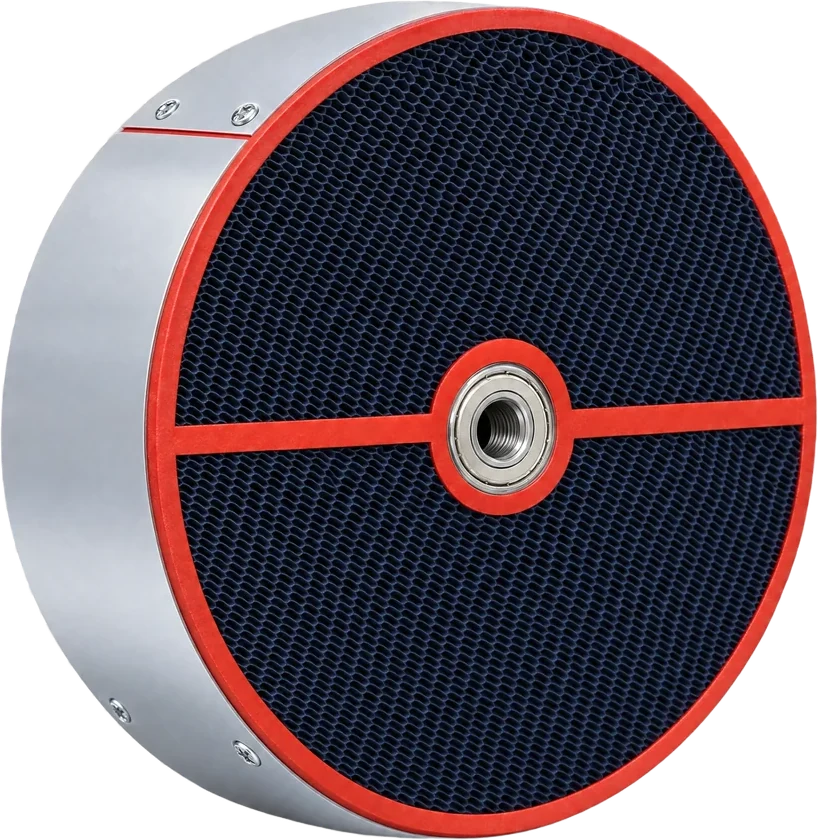
The cabinet is only sheet metal. What decides performance is one component: a ceramic-fibre honeycomb wheel, impregnated with silica gel or molecular sieve, turning slowly while the machine runs.
Impregnated, not coated
The desiccant is carried through the full depth of the ceramic-fibre honeycomb, so capacity does not sit in a surface layer that wears off in service.
Two separate air streams
Most of the wheel face dries the process air; a smaller sector is re-activated by the regeneration stream. Regeneration airflow and heating for every model are listed in the specification table.
Regeneration runs counter-flow
Regeneration air is heated and pushed through the wheel against the process direction, so the moisture leaves outdoors instead of back into the room.
No condensate, no drain
Moisture leaves as vapour rather than liquid — no drain pan, no pipe, nothing to freeze.
04
PRELIMINARY MODEL FINDER
Start with your process airflow.
Enter the process airflow you need and we suggest the smallest matching DZL model. Only know the room size? Send the floor area and ceiling height in the form and we work out the airflow with you. Low-dew-point and low-temperature processes still need an engineering fit check.
Preliminary estimate only — the published model list and confirmed operating conditions govern the final selection.
Enter a process airflow to see a suggested model. Selecting it loads the full parameters in the model range below.
05
MODEL RANGE
Choose a DZL model to view its full parameters.
Select a row below to update the technical data and pre-fill the inquiry form. Process airflow is a starting point only; final selection depends on inlet air condition, target humidity or dew point, and regeneration heat source.
FULL TECHNICAL DATADZL2000
- Dehumidification
- 12 kg/h
- Process airflow
- 2,000 m³/h
- Regeneration airflow
- 840 m³/h
- Regeneration heating
- 20 kW
- Installed power
- 22.35 kW
- Power supply
- 380 V / 50 Hz
- Weight
- 420 kg
- Unit dimensions (L × W × H)
- 1430 × 1000 × 1630 mm
*Published product data for preliminary evaluation. Rating conditions must be confirmed. Final confirmed specification and machine nameplate prevail.
17-MODEL CHECKLIST
Compare the published range
Click "Select" or any model row to load its complete specifications above.
| Choose | Model | Capacity | Process airflow | Power supply | Unit dimensions |
|---|---|---|---|---|---|
| DZL200 | 1.2 kg/h | 200 m³/h | 220 V / 50 Hz | 600 × 400 × 680 mm | |
| DZL300 | 1.8 kg/h | 300 m³/h | 220 V / 50 Hz | 600 × 400 × 680 mm | |
| DZL500 | 3 kg/h | 500 m³/h | 220 V / 50 Hz | 785 × 515 × 610 mm | |
| DZL600 | 3.6 kg/h | 600 m³/h | 220 V / 50 Hz | 785 × 515 × 610 mm | |
| DZL800 | 4.6 kg/h | 800 m³/h | 220 V / 50 Hz | 940 × 540 × 1200 mm | |
| DZL1000 | 6 kg/h | 1000 m³/h | 380 V / 50 Hz | 940 × 540 × 1200 mm | |
| DZL1500 | 9 kg/h | 1500 m³/h | 380 V / 50 Hz | 1430 × 1000 × 1630 mm | |
| DZL2000 | 12 kg/h | 2000 m³/h | 380 V / 50 Hz | 1430 × 1000 × 1630 mm | |
| DZL3000 | 18 kg/h | 3000 m³/h | 380 V / 50 Hz | 1620 × 1200 × 1800 mm | |
| DZL4000 | 24 kg/h | 4000 m³/h | 380 V / 50 Hz | 1620 × 1200 × 1800 mm | |
| DZL5000 | 30 kg/h | 5000 m³/h | 380 V / 50 Hz | 1730 × 1500 × 1830 mm | |
| DZL6000 | 36 kg/h | 6000 m³/h | 380 V / 50 Hz | 2820 × 1320 × 1660 mm | |
| DZL7000 | 42 kg/h | 7000 m³/h | 380 V / 50 Hz | 2820 × 1320 × 1660 mm | |
| DZL8000 | 48 kg/h | 8000 m³/h | 380 V / 50 Hz | 2820 × 1360 × 1780 mm | |
| DZL9000 | 54 kg/h | 9000 m³/h | 380 V / 50 Hz | 2820 × 1620 × 1680 mm | |
| DZL10000 | 60 kg/h | 10000 m³/h | 380 V / 50 Hz | 2820 × 1720 × 1880 mm | |
| DZL13000 | 80 kg/h | 13000 m³/h | 380 V / 50 Hz | 2820 × 1720 × 1880 mm |
Engineering reminderProcess airflow alone is not enough.
Send the inlet air condition, target humidity or dew point, regeneration heat source available on site, voltage and quantity.
06
WHERE THE DZL RANGE IS SPECIFIED
Processes that fail at ambient humidity.
In a tropical climate the dehumidifier is often fighting incoming fresh air, not the room itself. Tell us the air-change rate or fresh-air volume and the load calculation changes completely.
Food & seafood processing
Drying rooms, packing halls and chillers where condensation on product or packaging causes spoilage and rejections.
Cold storage & ante-rooms
Frost-free air at low temperature, so ice does not build on coils, floors or door frames.
Battery & electronics dry rooms
Assembly and storage held below ambient dew point to protect cells, coatings and solder joints.
Pharmaceutical & nutraceutical
Low-humidity production and storage areas where hygroscopic powders must stay free-flowing.
Printing, film & coating
Hygroscopic webs and film that stretch, curl or haze when relative humidity swings.
Agro, spice & tea drying
Low-temperature drying that protects colour, aroma and active content instead of cooking the product.
07
WHY DEYOUJIANG
Built for buyers far from the factory.
Your unit may run thousands of kilometres from us. So it is designed to be serviced on site, with spare parts we send free during the warranty.
- 1-year whole-unit warrantyFree spare parts for any problem within the warranty period.
- Modular design + fault self-diagnosisThe controller shows the fault. Swap the faulty module on site — no specialist repair, no shipping the unit back.
- MOQ 1 unitOne unit for a trial or a single room, or a full project order.
- FOB, EXW or door-to-doorExport packing and shipping documents. We export to Southeast Asia, Europe and the Middle East.
- Custom voltage and 50/60 HzEach unit can be built for your local power supply.
- Video installation guidanceMounting, ducts, regeneration exhaust, wiring and start-up — guided step by step by video with your installer.
08
HOW WE QUOTE
Why the same airflow can cost very differently.
Prices are quoted per project, because each rotor unit is configured to your air and your site. Send these six details and we come back with a clear written quotation.
Process airflow & moisture load
Rotor face area and regeneration section scale with the air you must dry — not with the floor area of the room.
Target dew point
A tighter outlet target needs more rotor depth, or a two-wheel ZH arrangement, to reach it reliably.
Regeneration heat source
Electric is the standard build. Steam, gas or waste heat changes both the machine and the running cost.
Voltage & site utilities
Published 220 V or 380 V, or a custom voltage and 50/60 Hz — each unit can be built for your local power supply.
Quantity & schedule
Single project unit, multi-unit order or repeat programme — each is quoted on its own commercial basis.
Packing & shipping terms
FOB, EXW or door-to-door delivery, export packing and the route to your port.
What you get back
A written quotation your engineer and your finance team can both act on.
- Recommended model, quantity and the margin of safety behind it
- Regeneration heat source matched to the utilities you actually have
- Datasheet, dimension drawing and utility schedule
- FOB, EXW or door-to-door price, with the lead time stated in writing
- Packing plan, document list and payment terms
09
COMMON QUESTIONS
Before you specify a rotor.
The questions buyers ask most often on the first call. If yours is not here, send it with the conditions and we will answer it in writing.
How is a desiccant rotor different from a refrigerant dehumidifier?
A refrigerant unit condenses moisture by cooling air below its dew point; frost limits it at low temperature. A desiccant rotor adsorbs moisture directly onto a silica-gel wheel and is re-activated by a heated stream, so it keeps drying at low temperature and low humidity.
Which DZL capacity is enough for my process?
It cannot be decided from room area alone. Capacity is checked against inlet air condition, target humidity or dew point, and the required process airflow. Use the model finder for a preliminary size, then confirm with the operating data.
Can it hold a very low dew point?
The single-wheel DZL range reaches low humidity for process air. For very low outlet dew points, staged drying with a two-wheel ZH combination is usually the better arrangement — send the target and we will say which applies.
Can regeneration use steam or gas instead of electricity?
Electric heating is the standard configuration. Steam, gas or waste-heat regeneration can be reviewed per project, and is often worth it on large units where running cost dominates.
What is the difference between the DZL and ZH series?
DZL is a single-wheel cabinet unit from 200 to 13,000 m³/h. ZH is a combined system built from rotor modules with a separate regeneration section, including two-wheel combinations such as ZH-1500+600 for staged drying.
Which countries do you export to, and at what voltage?
We export to Southeast Asia, Europe and the Middle East on FOB, EXW or door-to-door terms. Published supply: up to DZL800 220 V / 50 Hz single phase, DZL1000 and up 380 V / 50 Hz three phase. Custom voltage and 50/60 Hz: each unit can be built for your local power supply.
What is included in the quotation?
Model and quantity, regeneration heat source, datasheet and dimension drawing, utility schedule, FOB, EXW or door-to-door price, stated lead time, packing plan and payment terms. The confirmed specification and machine nameplate prevail in the end.
What do you need from me to quote?
Destination country, process airflow, inlet air condition, required outlet humidity or dew point, the regeneration heat source available on site, voltage and quantity. Anything you do not have yet can be left blank — we will ask.
What warranty do I get, and what if something breaks?
The whole unit has a 1-year warranty, with free spare parts for any problem within the warranty period. The unit is modular with fault self-diagnosis: the controller shows the fault and the faulty module can be swapped on site.
Can I order just one unit?
Yes. The minimum order is 1 unit. Prices are quoted per project after we check your conditions.
Who installs it?
A local HVAC or electrical installer can do it with our video installation guidance for mounting, ducts, regeneration exhaust, wiring and start-up. We are also recruiting distributors and service partners.
ZH
COMBINED DESICCANT SYSTEMS
Need more than one wheel?
The ZH combined series.
For large process drying lines, the ZH combined dehumidifier series builds a custom air path from multiple rotor modules and a separate regeneration section. Single-wheel units run from ZH-500 to ZH-5000, and two-wheel combinations such as ZH-1500+600 or ZH-4000+2000 stage the drying in two passes for very low outlet humidity.
- Modular process and regeneration sections, engineered per project
- Two-wheel combinations for staged drying at very low humidity
- Electric, steam, gas or waste-heat regeneration reviewed per project
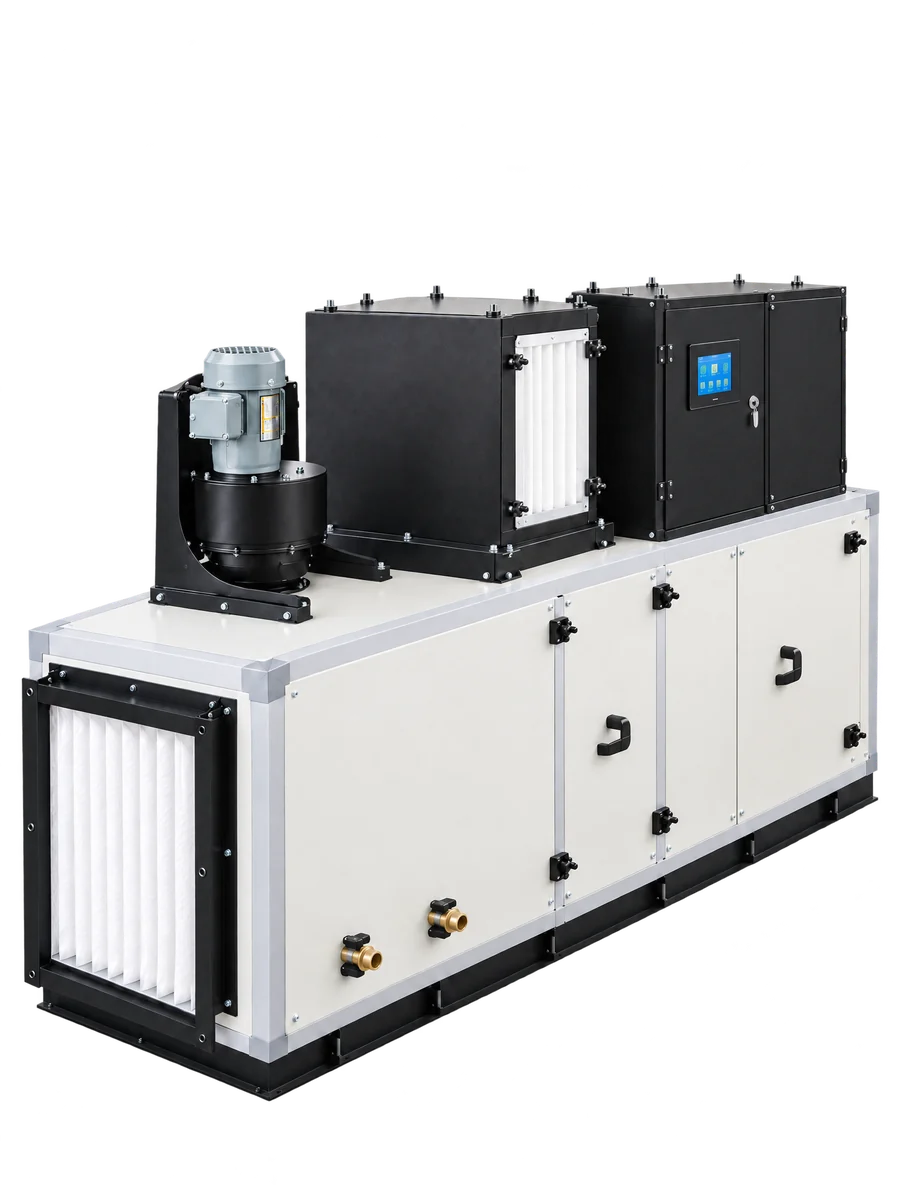
ZH combined series — modular process and regeneration sections
DZL SERIES ENGINEERING REVIEW
Send the process target.
We check the rotor fit.
A useful quotation starts with the required humidity or dew point and the regeneration heat available — not only the requested airflow. Send what you have; we will ask for the rest.
- Which model and quantity actually fits your conditions
- Whether your site can run steam, gas or waste-heat regeneration
- FOB, EXW or door-to-door price, stated lead time and packing plan
- 1-year whole-unit warranty with free spare parts
Prefer email? leo@hzdeyoujiang.cn