
Ice on coils and door frames
Moisture freezes on the evaporator and around the door. The coil needs more defrost cycles, and the room temperature swings during each one.
COLD ROOMS · CHILLED STORES · ANTE-ROOMS
In a cold room, warm and humid air comes in at every door opening. A refrigerant dehumidifier struggles there because its own coil frosts up. A DZL desiccant rotor unit adsorbs the moisture as vapour and sends it outdoors, so ice, wet floors and soggy cartons stop building up. Send your room size, temperature and target, and we reply with a model and a written quotation within 24 hours.
Quote within 24 hoursMOQ 1 unit · 1-year warrantyCustom voltage, 50/60 Hz
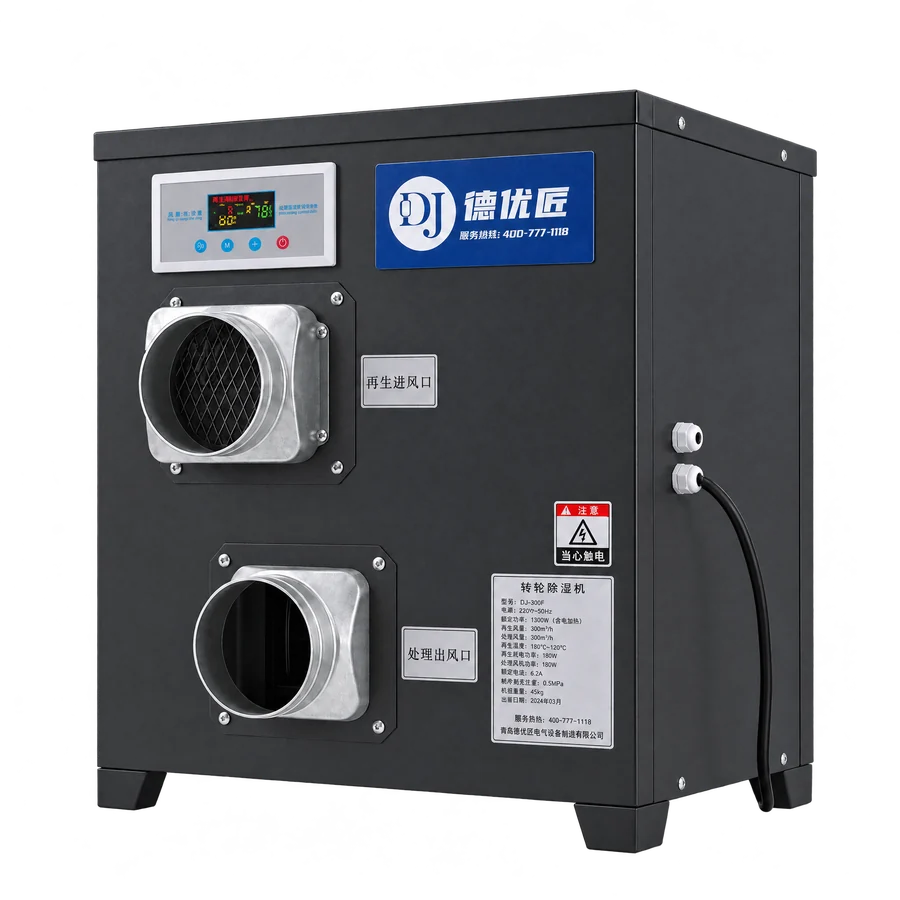
Compact models for small cold rooms, chilled stores and ante-rooms
FOB, EXW or door-to-door delivery
Free spare parts for any problem within the warranty period
Every unit can be custom-built for your local power supply
THE PROBLEM
Every door opening lets in warmer, wetter air, and warm product and wash-down add more. The evaporator holds the temperature, but it is not designed to control humidity, so in small chilled stores the relative humidity often climbs to 90–100% RH.
Moisture freezes on the evaporator and around the door. The coil needs more defrost cycles, and the room temperature swings during each one.
Condensate drips from ceilings, pipes and door frames and can freeze on the floor near the door — a hygiene and safety problem.
Cartons soften, labels become hard to read and goods kept in damp air can spoil sooner.
Damp walls, curtains and racks give mould and bacteria a place to grow.
The target that stops it: in small chilled stores, holding the relative humidity at a maximum of 70% RH stops condensation and the mould growth that follows. Your stored product may need a different value — tell us what you store.
WHY A NORMAL DEHUMIDIFIER STRUGGLES
A refrigerant dehumidifier has to make its coil colder than the air’s dew point. In a cold room that coil ends up below freezing, so the water turns to frost instead of draining away.
| Refrigerant / condensing dehumidifier | Desiccant rotor — DZL series | |
|---|---|---|
| How it removes moisture | Cools air on a coil until water condenses | A silica-gel rotor adsorbs moisture as vapour |
| In cold air | Frost forms on the coil; output falls as the room gets colder | Keeps drying — largely unaffected by a cold inlet |
| Where the water goes | Drain pan and pipe inside the cold zone, which can freeze | Out through the regeneration exhaust as warm, moist air — no drain |
| Best fit | Rooms at normal temperature | Cold rooms, chilled stores and their ante-rooms |
Honest check: if your chilled room runs well above freezing and only needs moderate humidity control, a refrigerant unit may be enough — send the conditions and we will tell you which technology fits before we talk about price. Our refrigerant range is on the DS / DSG / DG page.
HOW A ROTOR UNIT SOLVES IT
The DZL unit works next to your refrigeration, not instead of it. The refrigeration holds the temperature; the rotor takes care of the moisture.
Cold-room air is drawn through the rotor and returned drier. When door traffic is the main source, drying the ante-room or door zone is often the most effective place to start.
A separate heated regeneration stream re-activates the rotor and carries the moisture out through its own duct — nothing drips or freezes inside the room.
With less moisture in the air, less ice builds on coils, doors and floors, so defrost is needed less often and the room temperature stays steadier.
Electric regeneration is standard. Every unit can be custom-built for your local voltage, 50/60 Hz, and is modular with fault self-diagnosis for on-site service.
RECOMMENDED SMALL MODELS
These are the published figures for the compact and mid-size DZL models most often considered for small and medium cold rooms. The final model depends on room volume, temperature, door traffic and the moisture your product brings in.
| Model | Dehumidification* | Process airflow | Installed power | Published supply | Unit dimensions (L × W × H) | Weight | Link |
|---|---|---|---|---|---|---|---|
| DZL300 | 1.8 kg/h | 300 m³/h | 3.65 kW | 220 V / 50 Hz | 600 × 400 × 680 mm | 38 kg | Full data |
| DZL500 | 3 kg/h | 500 m³/h | 5.65 kW | 220 V / 50 Hz | 785 × 515 × 610 mm | 45 kg | Full data |
| DZL600 | 3.6 kg/h | 600 m³/h | 6.65 kW | 220 V / 50 Hz | 785 × 515 × 610 mm | 65 kg | Full data |
| DZL800 | 4.6 kg/h | 800 m³/h | 9.2 kW | 220 V / 50 Hz | 940 × 540 × 1200 mm | 110 kg | Full data |
| DZL1000 | 6 kg/h | 1,000 m³/h | 11.45 kW | 380 V / 50 Hz | 940 × 540 × 1200 mm | 160 kg | Full data |
| DZL1500 | 9 kg/h | 1,500 m³/h | 17.1 kW | 380 V / 50 Hz | 1430 × 1000 × 1630 mm | 350 kg | Full data |
*Published product data for preliminary evaluation. Dehumidification is stated at the published rating condition; at cold-room air conditions the actual capacity is different, so we confirm the model against your temperature and target before quoting. Published supply: DZL200–DZL800 220 V / 50 Hz, DZL1000 and larger 380 V / 50 Hz — every unit can be custom-built for your local voltage, 50/60 Hz. Larger rooms: see the full DZL range.
SIZING IN FOUR ANSWERS
Four answers are enough for a first selection. Photos of the room, the door and the iced-up coil help even more.
Length × width × height of the cold room, plus the ante-room if there is one, and the number and size of doors.
The temperature you keep the room at — and the temperature of the area outside the door.
A humidity target if you have one. If not, tell us what goes wrong: ice on the coil, wet floor, wet cartons, mould.
The product, how it is packed and how often the door opens in a busy hour.
A model recommendation and a written quotation your team can act on — within 24 hours of receiving your parameters.
COMMON QUESTIONS
If your question is not here, send it with your parameters and we will answer it in writing.
The refrigeration controls temperature, not humidity. Warm, humid air enters at every door opening and moisture also comes from warm product and cleaning. That moisture freezes on the coldest surfaces — usually the evaporator coil, the door frame and the floor near the door. Removing the moisture from the air is what stops the ice from coming back.
In a cold room its coil runs below freezing, so the water turns to frost, output falls and the unit spends time defrosting. A desiccant rotor adsorbs moisture as vapour and sends it outdoors, so it keeps working in cold air. If your room runs well above freezing and needs only moderate humidity control, send the conditions — if a refrigerant unit is enough, we will say so.
It depends on what you store. As a reference, holding small chilled stores at a maximum of 70% RH stops condensation and mould growth. Tell us the product and packaging and we will agree a target with you.
Usually outside the cold room or in the ante-room, with ducts for the dry air and a separate regeneration exhaust to outdoors. The best position depends on where the moisture comes in, so we confirm the layout from a sketch or photos of your room before quoting.
It depends on room volume, temperature, door traffic and the moisture your product brings in — not on floor area alone. Send the room size, temperature, target and what you store, and we reply with a model and a written quotation within 24 hours.
Tell us the room temperature when you send your parameters. For rooms below freezing we confirm the configuration with our engineers before we quote.
Published supply is 220 V / 50 Hz for DZL200 to DZL800 and 380 V / 50 Hz for DZL1000 and larger. Every unit can be custom-built for your local voltage, 50/60 Hz.
Yes, the minimum order is 1 unit. The whole unit has a 1-year warranty with free spare parts for any problem within the warranty period, and the modular design with fault self-diagnosis lets a local technician swap a faulty module on site.
Humidity figures on this page are typical published values for general guidance; your product, recipe and process set the final target.
COLD ROOM SIZING
Room size, temperature, target and what you store — that is enough to start. Leave blank what you do not know yet; we will ask.
Prefer email? leo@hzdeyoujiang.cn